“James, who’s Noah?” – I asked my husband.
There’s a silence that means someone hasn’t heard you, and a silence that means someone is confused, and then there’s the silence of a person calculating how much truth you already have.
I knew immediately which one this was.
Noah — five months old — existed between us for the first time out loud.
“Is he yours?”
“Yes.”
I don’t remember breathing. The refrigerator made its usual clicking noise. A chopstick lay across my plate, soy sauce dripping onto the table, and some part of my brain decided the important thing right then was to pick it up.
“Say it properly,” I told him.
“Elisabeth and I slept together. Houston.”
I went into the bathroom and locked the door. I didn’t collapse or scream.
I sat on the floor between the tub and the sink and thought, over and over: he has held his child.
He wasn’t ready to be a father
James told me he wasn’t ready to be a father twenty minutes before I found out he had a five-month-old son.
I know how that sounds. It took me longer than twenty minutes to understand it too.
We were eating leftover Thai food in our apartment in Frankfurt when I brought it up again — not dramatically, no tears, no ultimatum.
A friend had just sent me a photo of her newborn in a yellow blanket, and I showed James, and he said “cute,” and I asked if he ever thought about us having one.
“Of course,” he said, still eating.
“When?”
He gave me the half-smile I’d already seen in Chicago, in Warsaw, and now in Frankfurt. “Claire. I just don’t think I’m ready to be a father yet.”
Things had been “settling down” for seven years. I didn’t say that. I said what I’d trained myself to say.
“Okay.”
Twenty minutes later his laptop lit up on the kitchen table while he was in the shower.
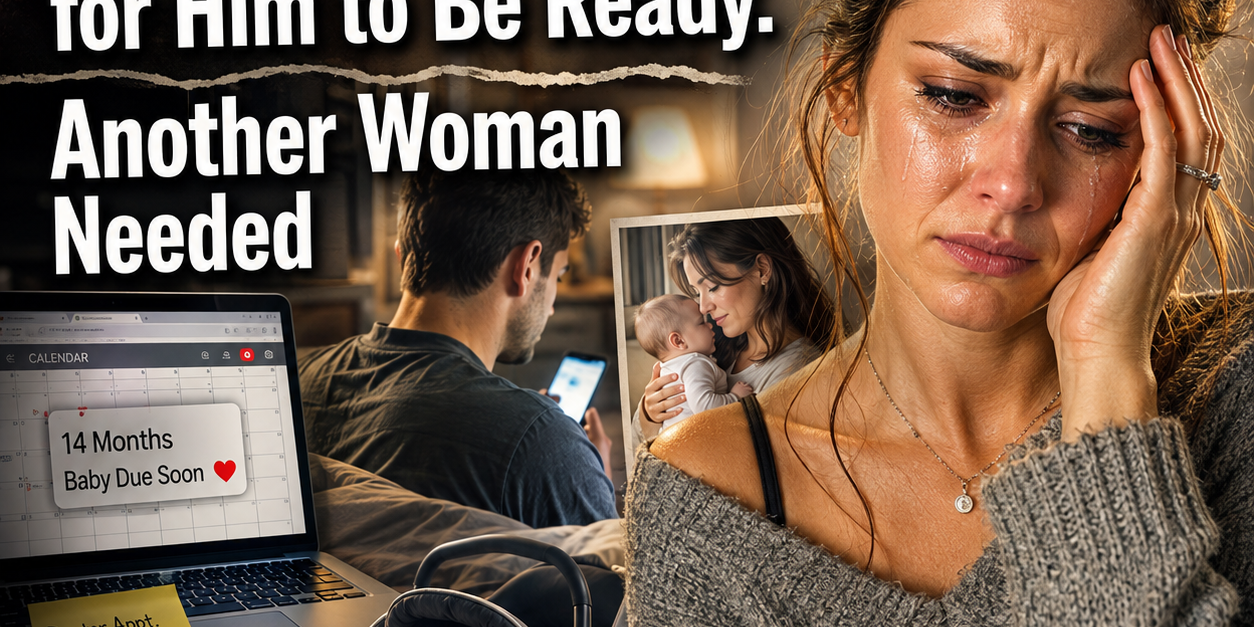
A calendar notification: Elisabeth + Noah — Pediatric follow-up, 2:15. Elisabeth meant nothing to me. Noah meant nothing to me.
Pediatric did.
I was still staring at it when the shower shut off.
“Who’s Noah?”
He didn’t answer right away. I watched him do the math — how much I already knew, how much he could still get away with not saying.
“It’s complicated,” he said.
Seven years of my life had apparently just become complicated.
“Elisabeth has a son,” he finally said.
“How old?”
“Five months.”
“How do you know when her son’s pediatric appointments are?”
He didn’t answer. And I understood — not everything, just enough — and sat down.
To understand why that moment broke something bigger than trust, you’d have to understand what “not ready yet” had already cost me.
James wasn’t the man my friends warn each other about. He remembered birthdays. He slept on the couch the winter I had pneumonia because my coughing kept waking him, then got up twice a night anyway to check my temperature. He knew I hated bananas but loved banana bread.
The day I failed my first licensing assessment in Warsaw, I came home humiliated and found he’d bought a cheap bottle of champagne. “What are we celebrating?” I asked. “The fact that you’ll pass the next one,” he said. I did.
That’s part of why I stayed. People like to say the signs were obvious after the fact. Mine weren’t — or some were, but they lived right next to a lot of good things.
His career was the hard part. International relocation, a new posting every eighteen to twenty-four months. Chicago became Warsaw. Warsaw became Frankfurt. Every move, we called it a joint decision. Technically it was.
His came with a raise. Mine came with paperwork — translations, assessments, supervised practice hours, credential recognition boards that don’t care how good you are, only whether the right stamp exists in the right country.
I still remember tearing open the envelope in our building’s lobby in Warsaw because I couldn’t wait for the elevator. Approved. I photographed it and sent it to James. Six champagne emojis came back. Three weeks later he came home with news of a promotion in Frankfurt.
“We don’t have to go,” he said, already explaining the salary, the title, the doors it would open.
I looked at the certificate on the table between us and did what I’d gotten very good at doing.
“Of course we’re going.”
By Frankfurt I’d stopped fully unpacking one particular box — an old banker’s box with reinforced corners, full of transcripts and notarized letters and supervised-practice records from three countries.
Proof I’d repeatedly qualified to become the same person. James once joked it had seen more of Europe than most Americans. I laughed. I always laughed.
Marriage came up occasionally. Children more, once I turned thirty.
He never said no. No would have been easier.
He said not yet, once we know where we’re staying, after this posting, when things settle.
Reasonable sentences — that was the problem.
Each one came with a future attached.
So I waited. When my mother asked at Christmas if we’d “talked about the future,” I defended him: his career is complicated. When my father asked why I kept restarting mine, I said it’s temporary.
Seven years
I said temporary for seven years.
In 2019, James was accepted into an executive MBA program in Boston. He told my parents it would set us up to finally choose where we lived — that word mattered, choose — and they gave him $38,500.
Some from savings. Some from refinancing part of their house. I remember my father’s pen running dry halfway through his signature, how he shook it twice and finished on the edge of an envelope.
“I won’t forget this,” James told him.
“You’d better not,” my father said. “You’re the most expensive son-in-law I’ve ever had, and you’re not even my son-in-law yet.”
We all laughed. James put his arm around me. “Give me time.”
“So I’ve heard,” my father said, smiling.
I think about that conversation more than I want to now.
Back in the kitchen, the chopstick was still between my fingers. I hadn’t noticed I was holding it.
“Say it properly,” I told him.
“Elisabeth and I slept together. Houston.”
Houston. Fourteen months earlier. A sales conference, four nights, a hotel room he’d complained faced the freeway. We’d talked for forty-three minutes on the second night. I checked, later. I wish I hadn’t.
“Did you use protection?”
He hesitated. That was the answer.
“She got pregnant?”
“Yes.”
“And you knew — for how long before he was born?”
“She told me a few weeks after Houston.”
Fourteen months stopped behaving like a number. It was Christmas. My birthday. His birthday. My mother’s surgery. A wedding in Prague.
Hundreds of dinners, hundreds of nights beside me — while, five months ago, he became a father, and I was still occasionally asking him when he thought he might be ready to become one.
“Have you seen him?”
“Yes. Several times.”
“Were you there when he was born?”
He didn’t answer.
“Did you hold him?”
His face changed, and that was worse than any answer he’d given so far.
Sex was betrayal. Holding the baby was a life — one that had already started somewhere else while I was still patiently waiting for ours to begin.
That’s when I finally got up and walked to the bathroom — the same four steps I’d take a dozen more times that week — and locked the door behind me. I didn’t collapse or scream. I just sat on the tile between the tub and the sink and let one sentence run on a loop: he has held his child.
Then, for about ten frightening minutes, I hated a woman I’d never met with an intensity that scared me. Then I hated myself for it. She hadn’t moved me across three countries. She hadn’t taken my parents’ money. She hadn’t sat at our Christmas table promising my mother that children were “definitely in the plan.”
James had.
I called my mother after midnight. She answered on the third ring the way mothers do when they already know something’s wrong.
I told her — Elisabeth, Houston, the baby, five months old, James at the hospital when he was born. Then the part I hadn’t wanted to say out loud: “He’s been paying for things.”
Silence. Then: “Does he still have the money your father gave him?”
I hadn’t even thought about that. The MBA was finished. There was nothing left to return.
“Your father refinanced the house because I told him James was family,” my mother said.
That sentence did what the baby hadn’t managed to do. I cried with my hand pressed over my mouth so James wouldn’t hear it through the wall.
“Come home,” she said.
I didn’t leave that night. I want to say I did — people like clean endings, woman discovers betrayal, woman packs a bag, woman chooses herself — but that wasn’t me. I stayed three more weeks.
Slept on the sofa. Twice, embarrassingly, I slept beside him, and the second time, when he put his arm around me in his sleep, my body remembered seven years for about thirty seconds before my brain remembered Houston. I hated myself the next morning.
He cried. He apologized. He offered therapy, passwords, a repayment plan for my parents. He said he loved me, and I believe he did — that’s the part people don’t like hearing.
I just don’t think his love ever required him to make the choices I’d spent seven years assuming love would eventually make inevitable.
“I was scared of losing everything,” he said once.
“What was everything?”
“Claire—”
“Because you weren’t scared enough of losing me to tell me.”
He didn’t have an answer for that either.
For a few days I still tried to solve it. Maybe this survives worse. Maybe seven years deserves more than one terrible decision.
Then I caught myself researching couples’ therapists in Frankfurt while my own professional license sat expired in a box under the bed, and something became clear:
I had spent seven years believing my patience was buying us time. It hadn’t. It had simply made it possible for nothing to change.
Every time James said not yet, I heard a timetable. I never once considered it might just be an answer.
When I finally packed, it didn’t take long. The furniture wasn’t mine. The apartment wasn’t mine — the lease was only in his name, “for the relocation paperwork.” Even the wine glasses belonged to the furnished unit.
What seven years actually looked like, reduced to objects, was: clothes, books, a framed photo from Warsaw, and the banker’s box.
The tape on one corner had split. Inside were all the versions of myself I’d kept putting on hold — Illinois, Poland, Germany, certified, expired, approved, pending, start again. Near the bottom, a folder from the year of his MBA, and inside it, for some reason, a photocopy of the paperwork my father signed — his signature fading exactly where the pen had run dry.
I sat on the floor with that page for a long time. Not only because of the money. Because I remembered how certain I’d been. I hadn’t just asked my parents to believe James. I’d asked them to believe me — that I knew where my life was going.
I didn’t.
I’m back in my childhood bedroom now, at thirty-three, two small holes still visible above the desk where a poster used to hang. My boxes fit against one wall.
That’s probably the saddest sentence in this whole story: seven years fit against one wall.
James still calls sometimes. For a while I checked his social media — wanting to see him unhappy, then wanting to see him happy so I could hate him properly, then, once, a photograph of a small hand that I closed the page on immediately.
He hadn’t done anything to me. He was just a baby. I’ve mostly stopped checking. Mostly.
I’m sitting my licensing exam again in July. I’ll need about sixty hours of supervised practice before I can work independently — a phrase that means something different to me at thirty-three than it did at twenty-seven.
This morning I opened the banker’s box and took out the Warsaw certificate. For years it was proof I’d once again built something his career required me to abandon.
I put it on the desk next to three clinics I’ve written down to call about supervision.
I haven’t called yet. Part of me is embarrassed to say: I’m thirty-three, I’ve been qualified before, but I need to start part of this over.
I spent seven years getting very good at starting over for someone else’s future.
Starting over for my own is harder.
The first clinic opens at nine tomorrow. I hate that I have to make the call.
I’m going to make it anyway.