
You scroll through quotes about self-discovery and buy books about “becoming yourself.”
You wonder when you’ll finally feel whole again. When you’ll recognize the person in the mirror. When you’ll remember what you even like anymore.
Here’s what nobody’s telling you: You’re not lost.
Lost implies you wandered off the path and need a map back. That’s not what happened to you.
What happened is your nervous system shifted into survival mode. And it’s still there.
Let me explain what that actually means—and more importantly, how to get out.
THE REAL PROBLEM: YOUR BRAIN IS PROTECTING YOU (BUT IN THE WRONG WAY)
When you were in that relationship, your brain learned something dangerous.
It learned that being yourself had consequences. Maybe your opinions caused fights. Maybe your needs made your partner withdraw. Maybe your personality was “too much” or “not enough.”
So your nervous system did what it’s designed to do: It helped you survive.
It dimmed your personality. Quieted your voice. Smoothed your edges. Made you smaller, easier, less threatening.
That wasn’t weakness. That was your brain trying to keep you safe.
But now the relationship is over. The threat is gone. And your nervous system doesn’t know that yet.
You’re still operating in survival mode even though there’s nothing left to survive.
That’s why you feel lost. Your brain is running outdated software. It’s still protecting you from a danger that doesn’t exist anymore.
The good news? Once you understand this, you can do something about it.
WHY “FIND YOURSELF” IS THE WRONG GOAL
Here’s where everyone gets it wrong.
They tell you to “find yourself” like you misplaced your identity somewhere between Whole Foods and his apartment. Like you need to go on some spiritual journey to rediscover your true essence.
That’s not how this works.
You didn’t lose yourself. Your self never went anywhere. It just got really, really quiet because being loud felt dangerous.
Think about it like this: When you’re in a house with someone who yells, you learn to walk softly. You learn which floorboards creak. You learn to make yourself small and quiet.
Now that person is gone. The house is empty. But you’re still tiptoeing.
You don’t need to find yourself. You need to give yourself permission to make noise again.

THE SURVIVAL MODE CHECKLIST: ARE YOU STILL IN IT?
Let’s figure out if you’re actually in survival mode. Check how many of these sound familiar:
Decision paralysis:
- You can’t choose what to eat for dinner
- You second-guess every choice
- You ask friends what they think before forming opinions
- You default to “I don’t care” or “whatever you want”
Emotional flatness:
- You don’t feel excited about things you used to love
- Everything feels muted or distant
- You can’t access anger even when something bothers you
- You cry randomly but can’t explain why
People-pleasing on overdrive:
- You apologize constantly for normal things
- You can’t say no even to things you don’t want to do
- You edit yourself before speaking
- You check everyone’s reactions before relaxing
Physical symptoms:
- You’re exhausted even when you sleep enough
- Your body feels heavy or disconnected
- You startle easily at loud noises or sudden movements
- You have trouble concentrating on simple tasks
Hypervigilance:
- You check your phone obsessively for their texts
- You monitor their social media
- You replay conversations looking for hidden meanings
- You’re always bracing for the next bad thing
If you checked more than three, your nervous system is still in survival mode.
The good news? This is fixable. Not with affirmations or vision boards. With actual neurological reprogramming.
HOW YOUR NERVOUS SYSTEM GETS STUCK (THE SCIENCE PART)
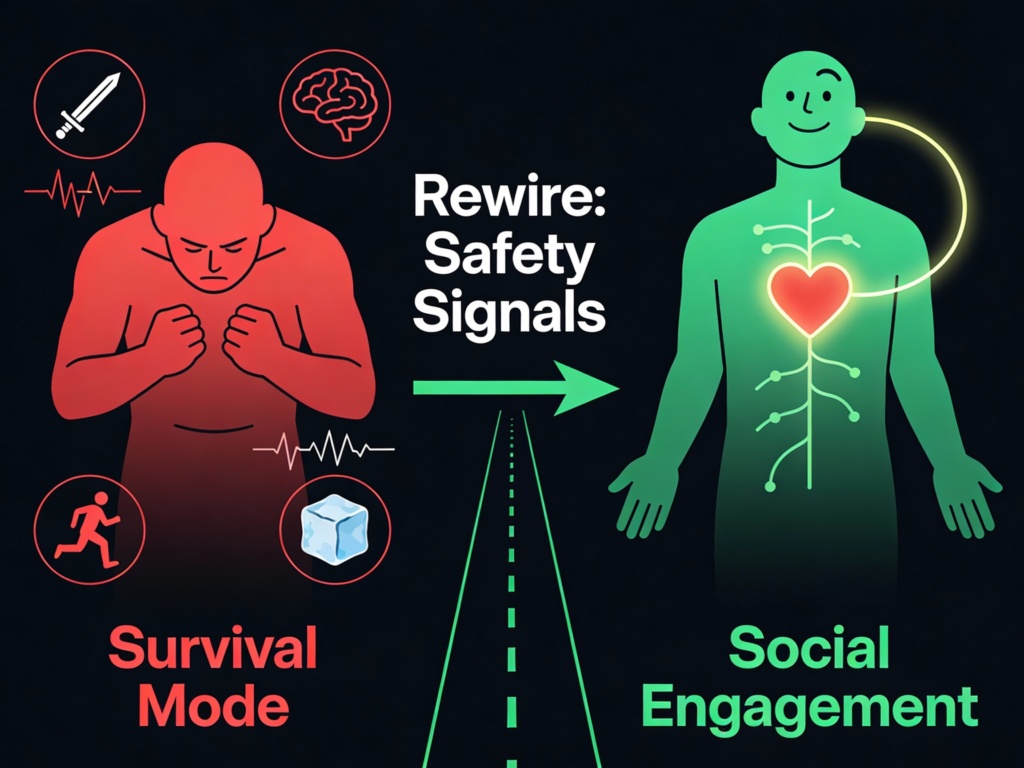
Your nervous system has two main states:
1. Social engagement mode (ventral vagal) This is when you feel safe. Your face is expressive. Your voice has range. You can be playful, creative, spontaneous. This is who you actually are.
2. Survival mode (sympathetic/dorsal vagal) This is when you feel threatened. Your body prepares to fight, flee, or freeze. Your creativity shuts down. Your personality flattens. You become whatever helps you survive.
In a relationship where you had to be small, your nervous system spent most of its time in survival mode.
And here’s the kicker: Your nervous system doesn’t distinguish between physical danger and emotional danger. Whether someone’s chasing you with a knife or making you feel like you’re too much—your body responds the same way.
It goes into protection mode.
Over months or years in that relationship, survival mode became your default setting. Your nervous system learned: “Being myself = danger. Being small = safety.”
Now the relationship is over. But your nervous system hasn’t gotten the memo yet.
It’s still running the old program. Still keeping you small. Still protecting you from a threat that doesn’t exist.
That’s why affirmations don’t work. You can’t think your way out of a nervous system state. You have to literally retrain your body that it’s safe to be yourself again.
THE EXIT PLAN: 4 PHASES TO REWIRE YOUR NERVOUS SYSTEM
Forget finding yourself. Let’s focus on getting your nervous system out of survival mode. Once you do that, “yourself” will show up naturally.
PHASE 1: SAFETY SIGNALS (WEEKS 1-2)
Your first job is convincing your nervous system that the threat is gone.
Not with logic. With signals.
Your nervous system doesn’t speak English. It speaks sensations, sounds, movements, and patterns. You have to communicate safety in its language.
Daily practices:
Morning safety ritual (5 minutes):
- Sit somewhere comfortable
- Put your hand on your heart
- Say out loud: “The threat is gone. I am safe right now.”
- Take five deep breaths: 4 seconds in, 6 seconds out
- Notice five things you can see that are actually safe (lamp, pillow, window, plant, wall)
Why this works: Slow breathing activates your vagus nerve—the main highway of your parasympathetic nervous system. Naming safe objects forces your brain to scan for safety instead of threat. Saying it out loud creates an external reference point.
Environment reset:
- Change something in your space every day this week
- Move furniture. Buy new sheets. Rearrange your desk.
- Paint a wall if you can. Hang different art.
- Wear clothes they never saw you in
Why this works: Your environment triggers memory. Every familiar object is a cue that tells your nervous system to run the old program. Changing your environment interrupts the pattern.
Physical discharge:
- Shake your body for 2 minutes (literally just shake)
- Jump up and down
- Push against a wall as hard as you can for 30 seconds
- Hit a pillow. Scream in your car.
Why this works: Survival mode creates stuck activation in your body. Physical movement discharges that activation. Animals do this naturally after threat—watch a gazelle shake after escaping a lion. Humans need to do it too.
PHASE 2: VOICE ACTIVATION (WEEKS 3-6)
Now we start training your system that it’s safe to have opinions again. To take up space. To make noise.
The opinion practice:
Every day, pick one tiny thing and state your preference out loud. Not in your head. Out loud.
Monday: Coffee order. Don’t say “whatever’s fine.” Say “I want a cappuccino.”
Tuesday: Restaurant choice. Don’t defer. Say “I’d prefer Thai tonight.”
Wednesday: Movie selection. Don’t say “I don’t care.” Say “I want to watch something funny.”
Thursday: Weekend plans. Don’t just go along. Say “I’d rather stay in.”
Friday: Music in the car. Don’t let someone else control it. Say “Can we listen to my playlist?”
Repeat for three weeks. Start small. Work up to bigger preferences.
Why this works: Every time you state a preference and nothing bad happens, your nervous system gets data: “Oh. Having opinions is actually safe now.” You’re literally retraining the neural pathways.
The boundary experiment:
Say “no” to one thing every week. Not to be difficult. To practice that the word won’t kill you.
- “No, I can’t help you move this weekend.”
- “No, I don’t want to go to that party.”
- “No, I’m not available for that call.”
Why this works: Survival mode believes saying no = abandonment. You need proof that boundaries don’t destroy relationships. Start gathering that proof.
The reclaim practice:
Do one thing every week that you stopped doing because they didn’t like it.
- Play that music they hated
- Cook that food they complained about
- Watch that show they never wanted to see
- Wear that outfit they criticized
- Contact that friend they were weird about
Why this works: Each time you do a “forbidden” thing and survive, you’re deleting the old programming. You’re teaching your system: “I can be myself and the world doesn’t end.”

PHASE 3: EXPRESSION EXPANSION (WEEKS 7-12)
This is where you start rebuilding your personality’s range. Survival mode flattens you. This phase adds dimension back.
The emotion activation:
Pick one emotion per week and express it deliberately:
Week 7—Anger:
- Write a rage letter (don’t send it)
- Hit a punching bag or do intense cardio
- Say out loud things that piss you off
- Watch something that makes you angry
- Notice where you feel anger in your body
Week 8—Joy:
- Do something purely fun with no productivity goal
- Laugh at stupid videos
- Dance to music you love
- Notice what genuinely makes you smile
- Let yourself feel pleasure without apologizing for it
Week 9—Sadness:
- Listen to sad music and actually cry
- Watch a movie designed to wreck you
- Write about what you’ve lost
- Let yourself miss things without trying to fix it
- Notice where you feel sadness in your body
Week 10—Playfulness:
- Be deliberately silly
- Make stupid jokes
- Do something childish
- Play a game with no winner
- Notice when you want to be serious out of habit and do the opposite
Week 11—Desire:
- Notice what you actually want (not what you think you should want)
- Say out loud: “I want…” and finish the sentence
- Do one thing purely because you desire it
- Notice where you feel desire in your body
Week 12—Peace:
- Sit in silence without distracting yourself
- Take a bath with no purpose except feeling good
- Notice moments of actual contentment
- Practice being with yourself without filling the space
Why this works: Survival mode shuts down emotional range. You’re either anxious or numb. This practice brings back emotional color and dimension. It proves to your system that it’s safe to feel everything again.
The personality audit:
Write down traits you used to have before the relationship. Ask old friends if you need help remembering.
Were you:
- Loud?
- Opinionated?
- Spontaneous?
- Weird?
- Funny?
- Intense?
- Passionate?
- Messy?
- Talkative?
- Quiet?
- Silly?
- Serious?
Pick three traits and practice them this week.
If you were funny, tell jokes. If you were loud, raise your voice on purpose. If you were opinionated, argue a position. If you were spontaneous, do something unplanned.
Why this works: Your personality traits didn’t disappear—they went dormant for safety. This practice wakes them up again. Shows your nervous system it’s safe to be those things.
PHASE 4: EXPANSION & INTEGRATION (MONTHS 4-6)
Now you’re not just surviving. You’re building a new version of yourself that includes everything you’ve learned.
The identity experiment:
Try on different versions of yourself. Not to find “the real you” but to explore your range.
Try for one week each:
- The version who dresses completely different
- The version who says yes to everything
- The version who says no to everything
- The version who’s more outgoing
- The version who’s more introverted
- The version who’s creative and messy
- The version who’s structured and organized
Notice which feel good. Which feel fake. Which surprise you.
Why this works: You’re not one fixed self. You’re a range of possibilities. Survival mode collapsed that range. This expands it again.
The purpose reclaim:
Answer these questions every morning for 30 days:
- What do I actually want today? (Not what I should want—what I want)
- What would make today feel meaningful to me?
- What’s one thing I can do today that’s just for me?
Why this works: Survival mode makes someone else’s needs your purpose. This practice redirects your purpose back to yourself.
The connection rebuild:
You can’t heal in isolation. Your nervous system needs co-regulation—being around safe people who reflect back your wholeness.
Find or create:
- One friend who knew you before the relationship
- One friend who never knew that version of you
- One group activity where you show up as yourself
- One person you can practice being “too much” with
- One community that celebrates what you were told to hide
Why this works: Your nervous system calibrates to the people around you. If you’re surrounded by people who expect you to be small, you’ll stay small. Find people who expect you to be big.
THE SIGNS YOU’RE EXITING SURVIVAL MODE
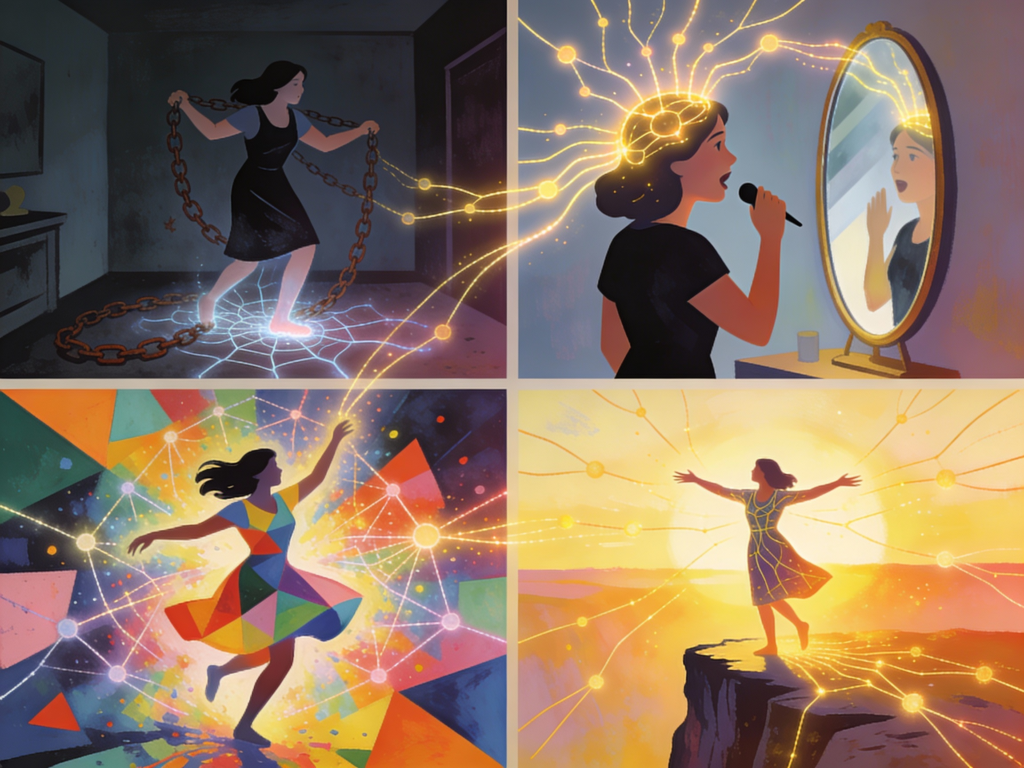
You’ll know it’s working when:
Week 2-4:
- You have a strong opinion about something small and it doesn’t scare you
- You sleep through the night once
- You make a decision without asking someone else first
- You notice you’re hungry and actually eat what you want
Month 2-3:
- Someone asks what you want and you know the answer
- You say no without excessive explaining
- You have a whole day where you don’t think about them
- You do something “selfish” and don’t feel guilty
- You laugh at something genuinely funny
Month 4-6:
- You recognize yourself in the mirror again
- You make plans based on what you want, not what’s safe
- Someone says “you seem more like yourself” and you agree
- You feel excited about something in the future
- You can be alone without feeling empty
Month 6+:
- You have strong opinions and express them
- You set boundaries without apologizing
- You pursue things you want even if they’re inconvenient for others
- You feel whole on your own
- You can remember the relationship without your body clenching
- You meet new people as the full version of yourself
- You don’t shrink around anyone
THE THINGS THAT WON’T WORK (SAVE YOURSELF THE TIME)
Let me save you six months of wasted effort:
What doesn’t rewire your nervous system:
- Positive affirmations (your nervous system doesn’t speak English)
- Vision boards (future focus when you need present safety)
- “Fake it till you make it” (faking triggers more survival mode)
- Dating someone new right away (your system will run the same program)
- Staying busy to avoid feeling (survival mode loves this—it reinforces running from yourself)
- Analyzing why the relationship ended (understanding doesn’t rewire)
- Trying to “get closure” from them (closure comes from you, not them)
What does rewire your nervous system:
- Physical practices that signal safety
- Micro-actions that prove new beliefs
- Co-regulation with safe people
- Deliberate expression of shut-down parts
- Environmental changes that interrupt patterns
- Consistent boundary practice
- Gradual nervous system state shifts
THE HARD TRUTH ABOUT TIMING
This takes 4-6 months minimum.
Not because you’re broken. Because that’s how long it takes to retrain a nervous system out of survival mode.
Week 1-2: Your nervous system will fight you. It thinks survival mode is keeping you safe. Expect resistance.
Week 3-6: You’ll have good days and terrible days. Terrible days don’t mean you’re failing. They mean your system is recalibrating.
Month 2-3: You’ll start feeling like yourself in moments, then panic and contract again. This is normal. Progress isn’t linear.
Month 4-6: The moments of feeling like yourself will get longer. The contractions will get shorter.
Month 6+: Being yourself will start feeling normal again. Survival mode will feel like the exception.
You can’t rush this. You can’t think your way out. You can’t will your way through. You have to actually rewire your nervous system with consistent practice.
Anyone who tells you there’s a faster way is lying.
WHAT TO DO WHEN YOU BACKSLIDE
You will backslide. Count on it.
You’ll have a week where you feel strong, then something triggers you—a song, a smell, someone who looks like them—and suddenly you’re back in survival mode.
When this happens:
- Name it: “Oh. My nervous system just went into survival mode. Makes sense.”
- Don’t panic: This isn’t failure. It’s your system trying to protect you from an old threat.
- Do the basics: Hand on heart. Five things that are safe. Deep breathing. Move your body.
- Don’t punish yourself: You’re not weak. You’re wired to protect yourself. That wiring runs deep.
- Get back to practice: One small thing today. One stated preference. One boundary. One expression.
Backsliding is part of rewiring. Your nervous system is testing whether the old pattern is still necessary. Each time you don’t run the old program, you make the new wiring stronger.
THE LETTER YOUR NERVOUS SYSTEM NEEDS
Read this out loud. Right now.
“Dear body,
I know you were trying to protect me. I know you made me small because being big felt dangerous. I know you shut down my voice because speaking up caused pain. I know you dimmed my light because shining bright got me hurt.
Thank you for keeping me safe. You did your job.
But the danger is gone now. The person who needed me to be small is gone. The environment that punished me for being myself doesn’t exist anymore.
I need you to update your programming. I need you to learn that it’s safe to be myself again.
I’m going to show you. Every day. With small actions. With stated preferences. With boundaries. With expression. I’m going to prove to you that being big is safe now.
I know you’ll resist. I know you’ll keep trying to protect me. That’s okay. I’m not mad at you. I understand.
But I need you to trust me. We’re safe now. It’s time to stop running survival mode. It’s time to come back online.
Let’s do this together.
I’ve got us.”
THE FINAL TRUTH
You’re not lost.
You’re in survival mode.
And survival mode is a brilliant adaptation that kept you safe when you needed it. But you don’t need it anymore.
The work now isn’t about finding yourself. It’s about signaling to your nervous system that the threat has passed. That it’s safe to have opinions again. Safe to take up space. Safe to be loud, messy, opinionated, weird, passionate, intense—whatever you are.
You’re not broken. You’re wired for protection. And now you’re learning to wire yourself for expansion.
This isn’t fast. This isn’t sexy. This isn’t spiritual or mystical or Instagram-worthy.
This is neurological reprogramming. And it works.
Four to six months from now, you won’t be the person you were before the relationship. You won’t be the person you were during the relationship.
You’ll be the person who learned how to protect herself and then learned how to stop.
You’ll be the person who knows the difference between survival mode and being alive.
And that version of you? She’s not lost. She’s not hiding. She’s not gone.
She’s just waiting for permission to come out.
Give it to her.